High Visibility Without Looking Boring
For a long time, "high-vis" meant a single thing: a shapeless fluorescent vest slipped over your jacket, the kind that made you look like a lollipop person on a Honda. The argument for wearing one was sound — being seen is one of the more controllable factors in motorcycle safety — but the aesthetics put a lot of riders off. That's changed. The current range of high-visibility motorcycle gear covers styles from technical adventure touring to classic leather, and the best of it manages to be conspicuous and genuinely attractive at the same time.
Why Visibility Matters
A significant proportion of motorcycle accidents involving other vehicles come down to the other driver not seeing the rider — or seeing them too late. Junction pull-outs are the classic scenario: a car emerges from a side road because the rider wasn't noticed in time. High-visibility clothing increases the distance at which other road users register your presence, which directly increases the time they have to react.
The effect is most pronounced in lower-light conditions — dawn, dusk, overcast days, and the kind of flat winter light that makes everything merge into the background. In bright sunshine the gain is smaller but still present. The cost of wearing high-vis on a day when it turns out not to be needed is minimal. The cost of not wearing it on a day when it would have mattered is not.
Fluorescent vs Reflective: Know the Difference
Fluorescent materials work in daylight — they absorb UV light and re-emit it as visible light, creating that characteristic brightness. They do nothing in the dark. Reflective materials are the opposite: invisible in daylight, but they bounce light from headlights back toward its source, making the wearer suddenly visible to oncoming drivers at night and in low light.
Good high-visibility gear combines both. A fluorescent base makes you conspicuous during the day; reflective panels do the same job at night. If you're choosing between a jacket with only fluorescent fabric and one with reflective panels on the back, shoulders, and cuffs, the second is more useful across the full range of riding conditions.
The Style Options Have Improved
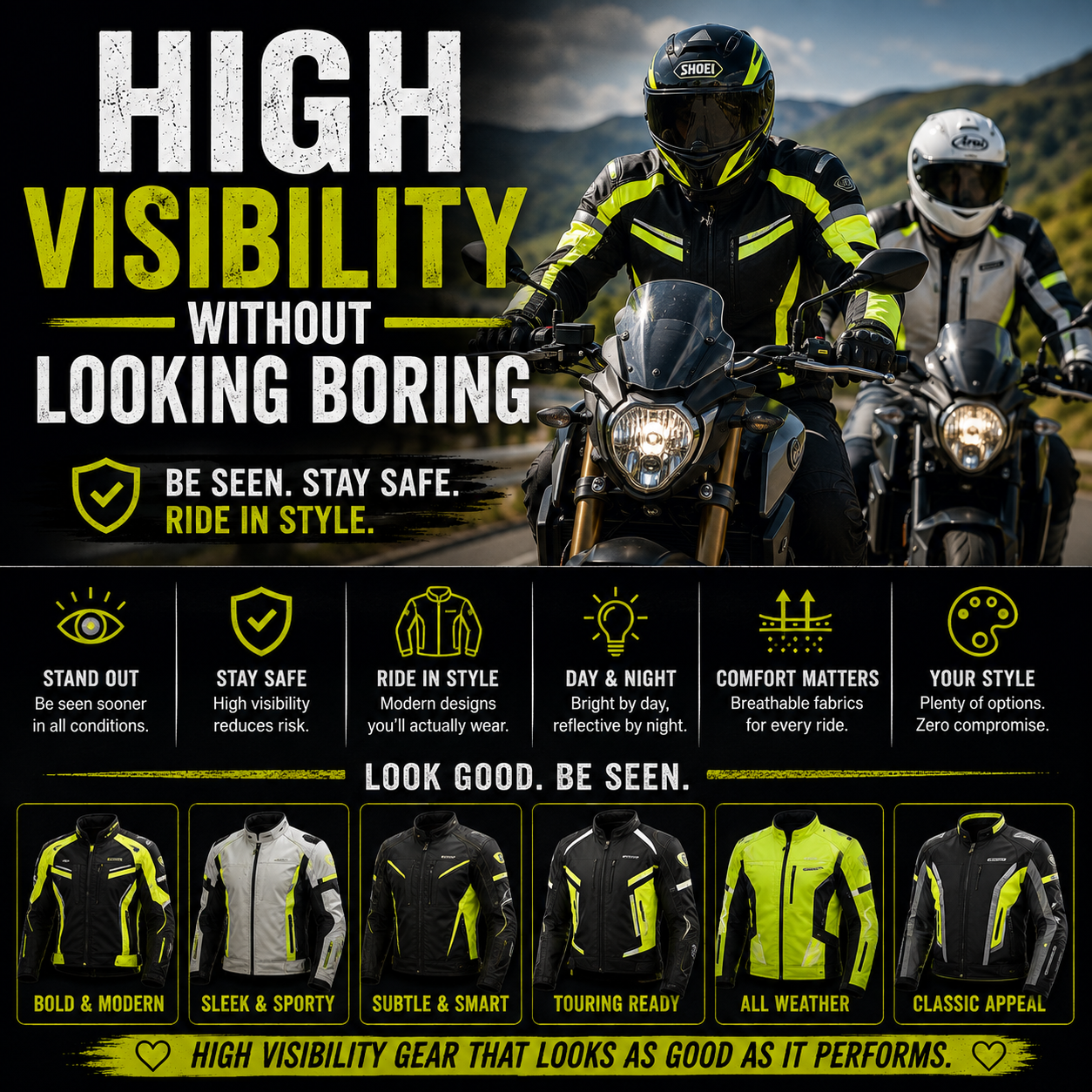
The fluorescent-vest-over-black-jacket look is still the cheapest option, and it works. But it's no longer the only one. Motorcycle jackets with integrated high-visibility panels now come in every major riding category:
Adventure touring brands have produced some of the most successful designs — jackets that work visually as technical outdoor kit, with strategic fluorescent and reflective panels that read as deliberate design rather than safety compromise. Some are genuinely handsome in a functional, expedition-ready way.
Urban and commuter jackets have followed, with designs that look as much like a quality softshell as a motorcycle jacket — muted fluorescent panels, subtle reflective detailing at the cuffs and hem, the kind of thing you'd wear off the bike without feeling conspicuous for the wrong reasons.
Even within the traditional leather jacket category, there are options: leather with reflective insets, lighter-coloured hides that provide better visibility than black without the hi-vis aesthetic, and jackets with removable reflective panels that can be added or taken off depending on the ride.
Helmet Visibility
The helmet is one of the highest and most visible points on a rider, and white or light-coloured helmets have consistently been shown to be more conspicuous than dark ones. If you're buying a new helmet, considering a light colour or one with prominent graphics is worth factoring in. For an existing dark helmet, reflective stickers or a helmet cover are a quick and inexpensive upgrade — particularly useful for night riding.
Adding Visibility to What You Already Own
If your current jacket is dark and you're not ready to replace it, a reflective vest over the top remains the most effective and cheapest option. Modern versions are more compact and better-fitting than the old tabard style. Some are designed to sit flat against the jacket rather than flapping in the wind, and pack down to almost nothing for carrying in a pocket or bag.
Reflective tape on pannier lids, top boxes, and helmets adds visibility at very low cost. LED light strips fitted to luggage are increasingly popular for touring riders who spend time on the road in varying light conditions. None of these require replacing gear you're otherwise happy with.
The Balance
Visibility gear works best when you actually wear it. A jacket you consistently skip because you dislike how it looks provides zero benefit. The right approach is to find the most visible gear you're genuinely willing to wear on every ride — not the most visible gear that exists. For most riders that means a jacket with integrated high-vis panels rather than a full-coverage vest, combined with a light helmet and reflective detailing on gloves or boots. It's a reasonable middle ground between the fluorescent extreme and the all-black look, and it's where the best of modern riding gear now sits.