How to Choose Your First Motorcycle Helmet
Your helmet is the single most important piece of kit you'll buy. Everything else — jacket, gloves, boots — matters, but the helmet is non-negotiable, and getting it right the first time makes a real difference. The good news is that once you understand what you're looking for, the choice becomes much clearer. Here's what to know before you buy.
Get the Fit Right First
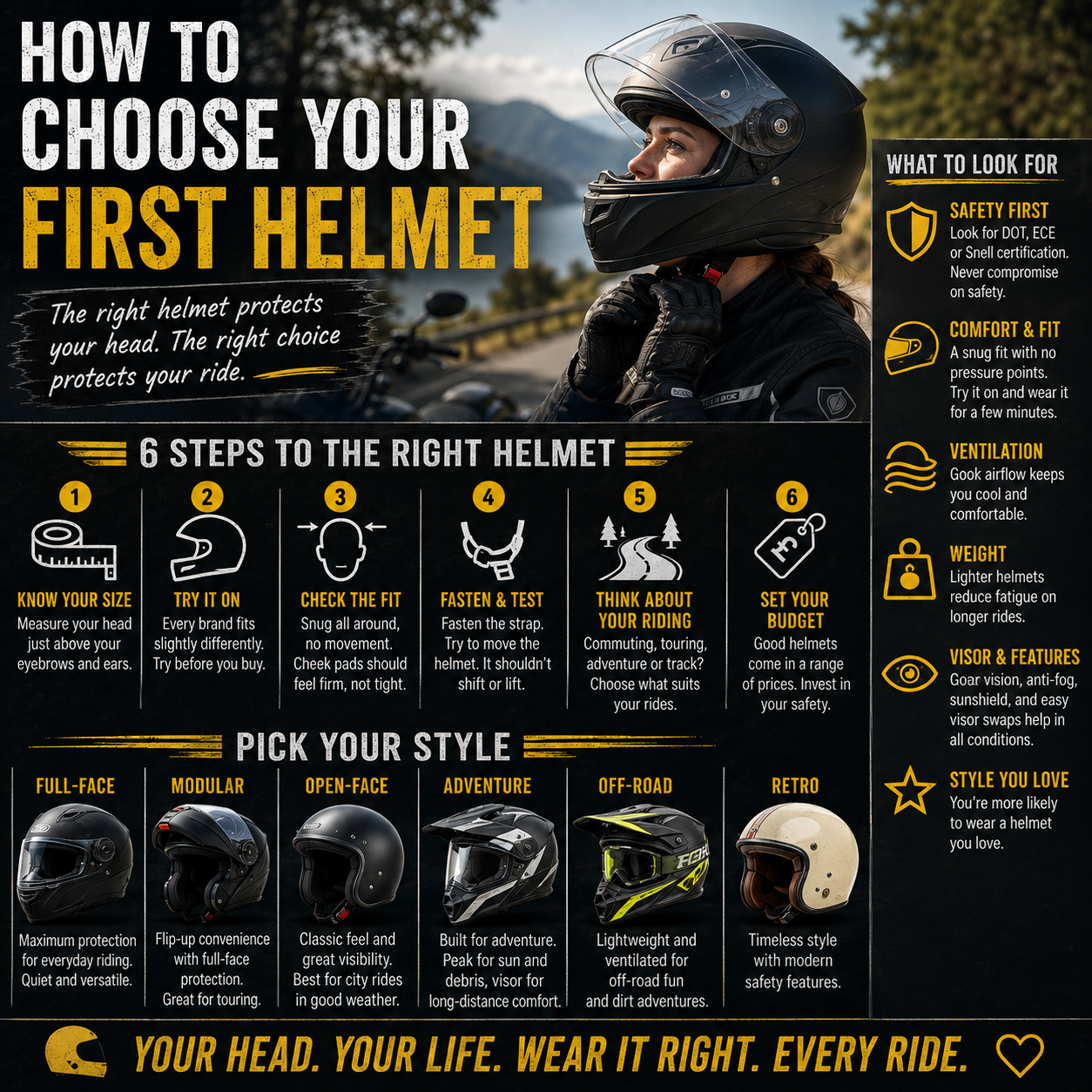
Fit matters more than brand, style, or price. A well-fitting mid-range helmet will protect you better than an expensive one that doesn't fit your head properly. The right fit means the helmet is snug all the way around with no gaps, no pressure points that cause pain after a few minutes, and no movement when you shake your head or push against it.
Head shapes vary — round oval, intermediate oval, and long oval are the main categories — and different helmet brands tend to cater to different shapes. The only reliable way to find out which suits you is to try helmets on in a shop. Don't buy a first helmet online based on size alone. Go in, try several, wear the shortlisted ones for at least five minutes each, and buy the one that still feels right at the end of that time.
Understand the Types
Full-face helmets offer the most protection, covering your entire head including chin and jaw. They're the sensible default for most riders, particularly beginners. The vast majority of serious head injuries in motorcycle accidents involve the chin bar — a full-face helmet addresses this directly.
Modular (flip-up) helmets allow the chin bar to be raised, which some riders appreciate for convenience at fuel stops or in traffic. They offer reasonable protection when closed, though the hinge mechanism means they're not quite as robust as a one-piece full-face. A good modular is a fair compromise; a cheap one is not.
Open-face helmets leave the chin and jaw unprotected. They're popular for urban and scooter riding, and for some classic and cruiser riders, but they offer materially less protection than a full-face. Worth understanding before you choose one.
Half helmets (skull caps) offer minimal protection and are not recommended as a primary helmet for road riding.
Check the Safety Rating
In the UK, a helmet must carry ECE 22.06 certification (the current standard) or the older BS 6658:1985 with ACU gold stamp to be legally worn on the road. Most new helmets carry ECE 22.06 — check the label inside the helmet or the manufacturer's spec sheet if you're unsure.
Beyond the legal minimum, the SHARP helmet safety scheme tests helmets independently and rates them from one to five stars. A five-star SHARP rating means the helmet performed well across a range of impact tests beyond what the standard requires. It's a useful guide when comparing helmets at a similar price point — all things being equal, the higher the SHARP rating, the better.
Set a Realistic Budget
You don't need to spend a fortune on your first helmet, but the very cheapest options — those that just scrape past minimum certification — tend to be heavier, louder, and less comfortable than helmets in the mid-range. A budget of £150–£300 will get you a well-constructed helmet from a reputable brand with a decent SHARP rating and features that make riding more comfortable: a good ventilation system, a quality visor, and a liner you can actually live with over the course of a full day's riding.
Spend more if you can and if the fit is right. Spend less if that's what the budget allows — a legal, well-fitting helmet at any price point will do its job. Just don't be tempted by uncertified helmets, however attractive the price.
Think About Features
Once you've established fit and safety rating, features become worth considering. Ventilation matters more than most beginners expect — a poorly ventilated helmet becomes unbearable on warm days and fogs the visor in the cold. A pinlock-ready visor (or one that comes with a pinlock insert) eliminates fogging almost entirely and is worth having from the start. A sun visor built into the helmet is convenient if you ride at varying times of day. Removable, washable liners are a quality-of-life feature you'll appreciate more over time.
Where to Buy
A physical shop is strongly recommended for your first helmet. The ability to try on multiple helmets, get advice from someone who can assess the fit in person, and leave with something you know fits correctly is worth the extra effort over ordering online. Once you know your head shape and the brands that suit you, buying online for subsequent helmets becomes much lower risk.